By Aimii | 19 May 2022 | 1 Comments
How To Read A 100W Portable Solar Panel Specification
100-watt portable solar panels are always the first ones for RVers when stepping into the solar energy. During the process of finding the best 100w portabel solar panels, you’ll see a lot of numbers and details on solar panel specification sheets. They help you make a detailed comparison between different portable panels. If you don’t understand what the numbers mean, it may as well be written in another language. So, in this article, we will be discussing how to read a 100w solar panel specification and which specs matter most?
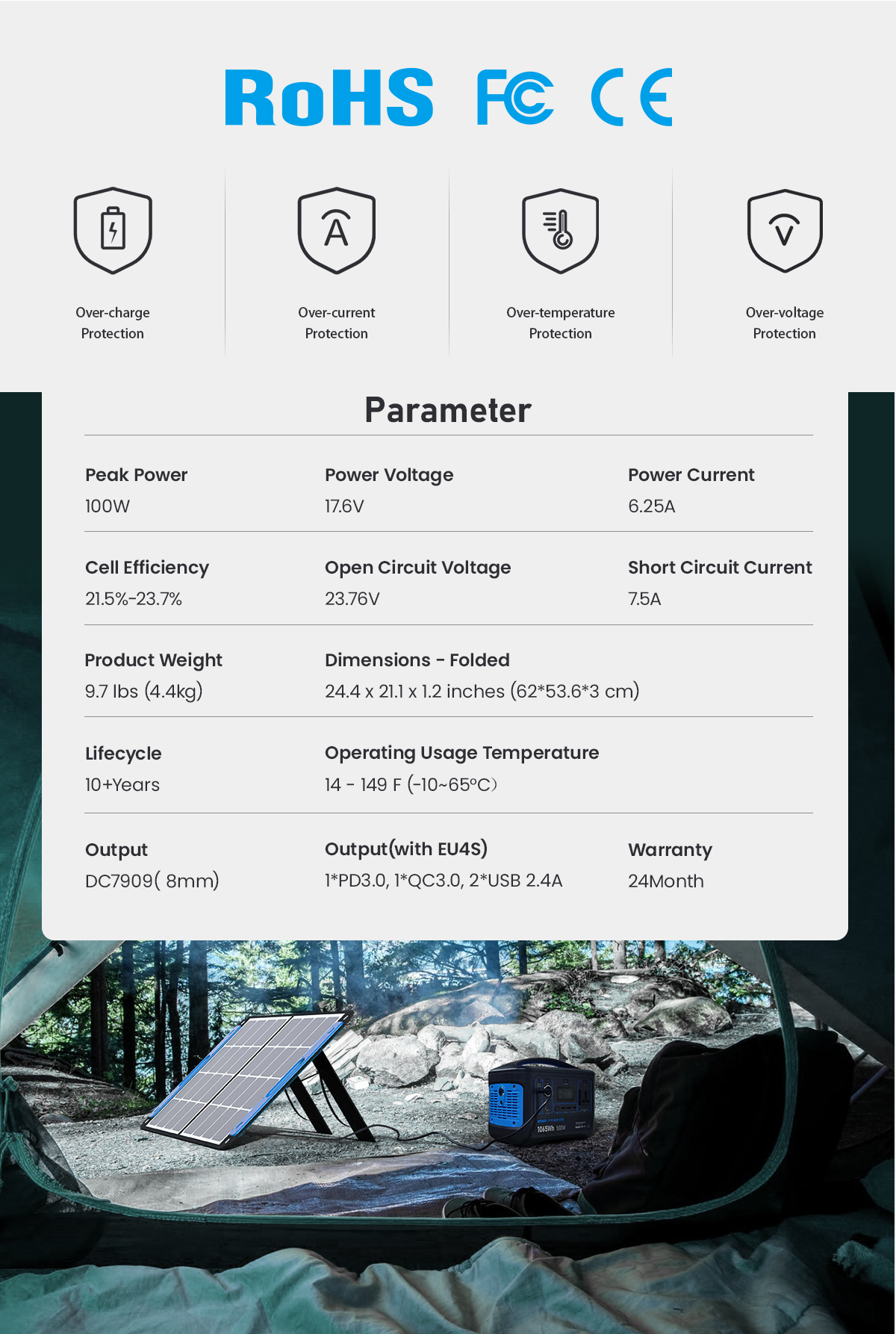
Here are the main specifications of XTAR SP100 portable 100w solar panel listed on the official page. The spec sheets give you all the information including panel dimensions and the power rating. Here’s what they mean.
The “smarts” inside an MPPT controller periodically measure the panel voltage under varying loads and then adjust the solar input circuit to balance the volts and amps and maximize the power output during the bulk-charge mode. Usually the Pmax = Vmp x Imp at standard test conditions.
Max power current or Imp, is the operating current at peak power output. The actual current varies with sun strength on the panel. Note that the current that a PWM controller will receive is slightly higher than the IMP under standard test conditions.
The Vmp and Imp are the key numbers for any solar panels. When you wire different solar panels in parallel, you should try to match the Vmp so that they work well together. And when you wire panels in series, try to match the Imp.
This number is also included to make sure you are using wiring and fuses with a rating strong enough for the system.
If you set up the portable solar panel at the proper angle and location, you could get significantly more current.
Note that all the functional ratings on the spec sheet come from standard test conditions. You buy a 100-watt portable solar panel that rates 100w of peak power, but in reality, you would probably get only 80w. That’s because there are so many factors that impact the solar power conversion when the panel works in actual real-world situations.
The panel may not always be in the best angle to the sun, or it is hot, scuffed, shaded, or just plain dirty. Also, the season and weather matter.
Then if you plan to add the panel to your existing solar power system, pay attention to the power voltage and power current. Match Vmp for the solar panels in parallel, and Imp for the panels in series.
Don't forget to match the open circuit voltage and short circuit current to your charge controller or inverter. Finally, see the weight, size, lifecycle, output ports, and warranty. Also, the price is an important consideration.
OK, then, it’s time to take action! Choose your best 100w portable solar panels and set up your solar system based on the above explanation.
Understanding specifications of 100w portable solar panels
Here are the main specifications of XTAR SP100 portable 100w solar panel listed on the official page. The spec sheets give you all the information including panel dimensions and the power rating. Here’s what they mean.
Peak Power
What is the peak power of a portable solar panel? Maximum power (Pmax), peak output power point, describe the maximum wattage a portable panel can generate under ideal conditions. This happens when the combination of the amps and volts results in producing the greatest wattage.The “smarts” inside an MPPT controller periodically measure the panel voltage under varying loads and then adjust the solar input circuit to balance the volts and amps and maximize the power output during the bulk-charge mode. Usually the Pmax = Vmp x Imp at standard test conditions.
Power Voltage (Vmp) & Power Current (Imp)
Max power voltage or Vmp, is the operating voltage at peak power output. In practice, the actual VMP will vary during a day with temperature, shading, soiling of the panel surface, etc.Max power current or Imp, is the operating current at peak power output. The actual current varies with sun strength on the panel. Note that the current that a PWM controller will receive is slightly higher than the IMP under standard test conditions.
The Vmp and Imp are the key numbers for any solar panels. When you wire different solar panels in parallel, you should try to match the Vmp so that they work well together. And when you wire panels in series, try to match the Imp.
Open Circuit Voltage (Voc)
It is the operating point under zero loads (the solar panel isn’t connected to anything), current and power output equal zero. The Voc rating is important to know for compatibility purposes when you establish your solar panel system. The Voc + approx 3.5% must be within the acceptable input range of your solar charge controller. If two or more panels are wired in series, it should be Voc of panel 1 + Voc of panel 2, etc. So this is the number to use when determining how many solar panels you can wire in series going into your inverter or charge controller.Short circuit current (ISC)
This reading describes the operating point with shorted output, voltage and power output equal zero. It is the current that flows out the panel when the positive and negative leads are shorted together. This is the highest current the portable solar panel will produce under standard test conditions. The Isc +20% determines how many amps a compatible solar charge controller or inverter can handle.This number is also included to make sure you are using wiring and fuses with a rating strong enough for the system.
If you set up the portable solar panel at the proper angle and location, you could get significantly more current.
Cell efficiency
This rating is the key point of the comparison of different solar panels. A portable monocrystalline solar panel has a higher efficiency than polycrystalline cells. The very best portable monocrystalline solar panel are around 23% efficient. XTAR 100W portable solar panel is at 23.7% cell efficiency.Dimensions: Length / Width / Thickness / Weight
The panel size and weight is the easiest number to understand. Knowing the size of the panel will give you an idea of how much space you need for the storage. For small travel trailers and RVs, it’s important to have a portable solar panel of small size. And as you need to set up and remove the panel, a lightweight portable solar panel is a good choice.Note that all the functional ratings on the spec sheet come from standard test conditions. You buy a 100-watt portable solar panel that rates 100w of peak power, but in reality, you would probably get only 80w. That’s because there are so many factors that impact the solar power conversion when the panel works in actual real-world situations.
The panel may not always be in the best angle to the sun, or it is hot, scuffed, shaded, or just plain dirty. Also, the season and weather matter.
Conclusion
Now let's make a conclusion. If you want to pick up the best 100w portable solar panels, you need to first look at the peak power and cell efficiency to judge the wattage needed.Then if you plan to add the panel to your existing solar power system, pay attention to the power voltage and power current. Match Vmp for the solar panels in parallel, and Imp for the panels in series.
Don't forget to match the open circuit voltage and short circuit current to your charge controller or inverter. Finally, see the weight, size, lifecycle, output ports, and warranty. Also, the price is an important consideration.
OK, then, it’s time to take action! Choose your best 100w portable solar panels and set up your solar system based on the above explanation.
Recently Reviews
READ MORELeave a Reply
Your email address will not be published.Required fields are marked. *